JN: a brief history of ‘a divine comedy’
By Cal Samra
Editor, The Joyful Noiseletter
© Copyright 2010 The Joyful Noiseletter
The Joyful Noiseletter and the Fellowship of Merry Christians may have started, ironically, under a giant saguaro cactus in Carefree, Arizona, 33 years ago.
I was in the depths of depression and despair. Everything that could go wrong had gone wrong in my life. My health had greatly deteriorated, forcing me to resign my job in Michigan as a newspaper reporter and, on my doctor’s advice, to go to the warmer climate of Arizona.
I was jobless, looked like skin and bones, weighing barely 103 pounds, and in great physical and emotional pain. I was full of bitterness, anger, self-hatred, fear, and doubt, and considered myself the most miserable of men.
An urge to be finished with the pain overwhelmed me one sunny, beautiful morning. I bought some sturdy clothesline rope at a hardware store and drove all over Phoenix looking for a suitable tree to hang myself from.
But the palm trees were much too tall to climb, so I finally drove into the desert near the elegant town of Carefree, sat in the sun next to a giant cactus, with its excruciatingly prickly spine, and for a couple of hours tried to figure out how to hang myself from it. How do you hang yourself from a cactus? Could I go down in history as the first person to hang himself from a tall cactus?
Finally, I decided that it was all very ridiculous, and that there was no way it could be done – not from a giant cactus, and I began laughing at my ineptness.
Then I got into my car and drove over to Scottsdale where I happened to pass by a Franciscan retreat center. Though my family roots had been in the Greek Orthodox faith, I was attracted to the beauty of the retreat center. I stopped by and entered the chapel, where I found myself down on my knees, praying for the strength to endure my pain and to go on in spite of it.
A warm-hearted Franciscan priest, Father Gavin Griffith, an Irish wit who could have made a living as a stand-up comedian, invited me to share a meal with him. At dinner, Fr. Griffith had me laughing again with his whimsical remarks and jokes.
I remember seeing on a kitchen wall a drawing of Jesus with a big smile on his face, the first such portrayal I had ever seen.
Another Franciscan gave me a gift of a print of a smiling Christ. The print of a smiling Christ gave me a different perspective on Jesus and cast him in a new light.
The effervescent and good-humored friars and sisters at the Franciscan retreat center, as well as Fr. Tom Walsh, a Scottsdale humorist and counselor who taught seminars on “stinkin’ thinkin’,” showed me how to reach out again to other people, and to laugh again. They helped reignite my faith and my sense of humor.
I discovered that when you are down-and-out and you pray for help, the Lord never fails to send people to you who will help you in one way or another, people who will cheer and lift you up, people who will encourage you, people with a variety of different healing gifts, people from a host of different faith traditions.
Friends you least expect
But God does not always send the people you expect. Often he sends the people you least expect.
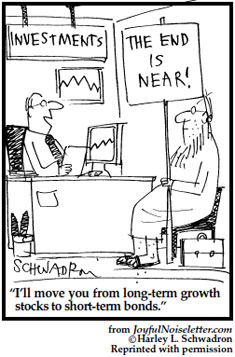 I connected with a prayer group that met in friends’ homes, and included a motley group of pastors, mainline Protestants, Catholics, evangelicals, and charismatics. The prayer support from these diverse Christians, I believe, was critical to my recovery.
The Franciscans frequently recited a 12-century prayer composed by the joyful and witty St. Francis of Assisi: “Lord, make me an instrument of Your peace – where there is hatred, let me sow love; where there is injury, pardon; where there is doubt, faith; where there is despair, hope; where there is darkness, light; where there is sadness, joy…”
We were to discover, again and again, that some of the greatest joy, humor, and comedy have sprung from people in times of great pain and sorrow.
In Phoenix, God also sent me a merry-hearted Jewish friend who became my tennis doubles partner. Lou Berman was 73 then, but he had been playing tennis – good tennis – on two artificial hips for more than 10 years, even though he was often in pain. His unfailing cheerfulness, keen sense of humor, kindness, and courage were a source of great inspiration for me.
Until I met Lou, I had taken tennis – and life – far too seriously. Lou taught me how to have fun at the game. He would sometimes reach back into the centuries-old wisdom of his faith to quote Proverbs 17:22 – “A cheerful heart is a good medicine, but a downcast spirit dries up the bones.”
In Phoenix, I returned to playing tennis almost daily, and the sun, fresh air, and aerobic exercise did wonders for the health of a burned out middle-aged man. That story is told in my 2009 book The Funny Side of Tennis – which is about the longevity of tennis players who play with good humor and good nutrition into their 80s and 90s.
My nutrition-minded family physician suggests other important factors in my recovery: I stopped smoking, stopped eating junk foods and fast-foods, and returned to the natural Mediterranean diet that my mother raised me on – lots of salads, fresh vegetables and fruits, whole grains, fish, and cheese.
Within six months I became physically fit, regained my normal weight, and was bursting with energy that I had not known before. I have found in my own pilgrimage that God uses many instruments of healing: medical doctors, nurses, clergy of all faith traditions, friars and nuns, charismatic laymen and women, singers, clowns, comedians, and humorists.
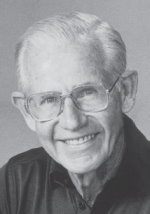
Bil Keane
Family Circus
Cartoonist
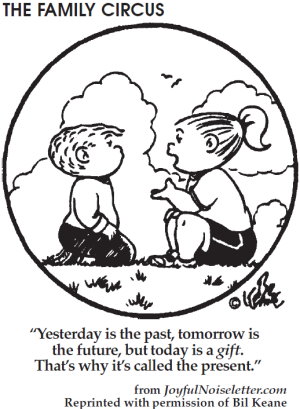
I cherish an original Family Circus cartoon that our friend Bil Keane gifted us. See top of this article.
My love, the love of family and mutual friends, and the love of Jesus solidified my healing.
I believe in a Christ who knows pain and suffering but who is also a joyful Christ with a divine sense of humor – a healing Christ who used humor, as well as prayer and compassion in his healing ministry. He was a joyful Spirit when he walked this earth, and supremely joyful at his resurrection.
I searched the Old and New Testaments and found numerous references to joy. In one New Testament concordance, there are 287 references to joy, gladness, merriment, rejoicing delighting, laughing, etc.
I was surprised to discover that on the very eve of his crucifixion Jesus admonished his disciples at the Last Supper: “These things I have spoken to you, that my joy may be in you, and that your joy may be full.” (John 15:11).
Joy! Here’s a man about to be arrested, tried, cursed, beaten, spit upon, humiliated, tortured, crucified, and he’s talking about joy!
Jesus imparted a spirit of joy to his disciples and taught them to be joyful even in the face of adversity, tribulations, affliction, and death.
This was no gloomy Messiah
This was no gloomy Messiah. We know that children were attracted to Jesus, and flocked to be near him. In any age, children are never attracted to melancholy or stern grumps. It was clear that Jesus was the antidepressant of the early Christians.
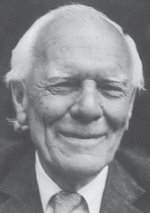
Malcom
Muggeridge
‘St. Mugg’
It occurred to me that perhaps one of the reasons Jesus was persecuted was because his joyful and witty personality was not only challenging but also contrasted so dramatically with the stern, grumpy, pagan- and religio-politicians of his time.
Jesus, “the Great Physician,” was also a very physical Messiah, a carpenter by trade who walked great distances every day in a hilly countryside and climbed mountains. He ate a natural Mediterranean diet and clearly was very physically fit.
I also studied the lives and writings of many Eastern Orthodox, Catholic, and Protestant saints and religious leaders, and found this same element of joy running through their lives, whatever hardships or illnesses they experienced.
We then put together a book titled Jesus Put on a Happy Face: The Healing Power of Humor. We sent the manuscript to 14 Protestant and Catholic publishers and collected enough rejection slips to wallpaper our bathroom.
So we gathered our meager savings, self-published it, and offered it to a small church mailing list. It quickly sold out 4,000 copies.
Harper & Row later purchased the book, changed the title to The Joyful Christ: The Healing Power of Humor, and sold about 80,000 copies over the next few years. Humorist Erma Bombeck gave us permission to print her entertaining letter to Fr. Tom Walsh on the healing power of humor in the prologue to the Harper edition.
Many pastors of all Christian faith traditions read the book when it was first published, and wrote to us suggesting that we publish a regular newsletter featuring jokes that pastors could tell in their sermons, and humor and cartoons that they could reproduce in their church publications.
These pastors thought that churches generally were getting too grim. We searched the library of a Michigan seminary and couldn’t find the word “humor” indexed anywhere.
The pastor & Groucho Marx
There is a story about a pastor who spotted Groucho Marx in a hotel lobby. The pastor was wearing a clerical collar and he rushed over to Groucho, shook his hand, and said, “Thank you, Groucho, for bringing so much joy into the world!”
“Thank you,” Groucho replied, “for taking so much joy out of it.”
So many churches then (and now) were peddling a joyless and humorless Christianity and were turning off and losing members, especially young people.
In those days, a lot of pastors and seminarians were so immersed in costly psychobabble that they were blind to the healing power of prayer, faith, good humor, good cheer, good nutrition, fresh air, sun, regular exercise, and quiet and beautiful surroundings.
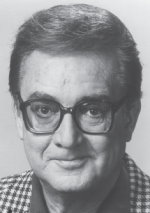
Steve Allen
Advocate for
clean comedy
I was very impressed by a marvelous book by Norman Cousins, the editor-in-chief of The Saturday Review. Cousin’s book, The Anatomy of an Illness, described how he had laughed his way through a supposedly incurable illness by watching old Laurel and Hardy, Marx Brothers, and Candid Camera movies.
But a lot of the humor in the news media, the Internet, and TV was downright joyless, cynical, and ugly. It tended to tear people down rather than lift them up. Not all humor is good medicine.
I decided to use our savings to publish a newsletter that provided inspirational humor to churches, health professionals, and families – humor that cheers people up, that inspires them.
The words “humor” and “humility” have the same Latin root (humus: “of the earth”), suggesting how far each of us has fallen short of the glory of God.
The Joyful Noiseletter was born 33 years ago in Kalamazoo, MI, where we had moved to be near my family, and it has been a wild ride ever since. But a really fun ride. Within our limited space, this article will provide some highlights, vignettes, and precious memories on this wild ride.
Being of a frugal frame of mind, we started out in the basement office of our home, and 33 years later, we’re still in the basement office of our home.
‘Make a joyful noise to the Lord’
We came up with the name for the newsletter from Psalm 98:4 – “Make a joyful noise to the Lord, all the earth.” The Joyful Noiseletter was to become “a voice laughing in the wilderness.” Our masthead declared: “Our modest aim is to recapture the spirit of joy, humor, unity, and healing power of the early Christians.”
- JN sought humor that – in tandem with faith – is a powerful healing tool, a bridge-building tool, a peace-making tool. The humor JN published would be clean.
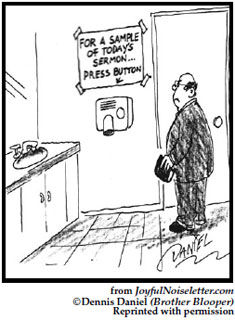 JN sought to bring Christians of all faith traditions together by focusing not on the things that divided them but on the things that united them, especially the joy of Jesus’ resurrection. (No easy task. “Who are Christians?” Pastor Chris Anderson once was asked. He replied: “People who follow Jesus, though they often think he went in different directions.”)
- JN sought to recover the joy and humor of the Easter season by encouraging churches to revive an old custom begun by the early Greek Christians with ongoing celebrations of Jesus’ resurrection on the Sunday after Easter – “Bright Sunday” or “Holy Humor Sunday.” All Christians – whatever their differences – could rally around the resurrection. (See the free online guidebook to Holy Humor Sunday here).
- JN would strive to be respectful and fair to all faith traditions, and reflect the variety of views of our subscribers. We would demonize no one.
- There would be nothing deadly serious in JN. (Ever heard of anything “deadly humorous”?)
- JN would carry no advertising, and no ads for pills for male enhancement or female incontinence. We would be entirely commercial-free.
- JN would protect the privacy of its subscribers and not sell its sizable mailing list.
- We would respond courteously and swiftly to everyone who inquired for information or orders. (And our splendid fulfillment service, First Fulfillment, Inc. of Kalamazoo, has done exactly that.)
There is an old tradition in early Eastern Christianity that Lazarus laughed heartily for years after Jesus raised him from the dead, and Lazarus’ home in Bethany was called “the House of Laughter.”
We sought to build a “House of Laughter” at the Fellowship of Merry Christians, and found that humor, like love, crosses denominational lines.
One of JN’s consulting editors, Msgr. Arthur Tonne of Marion, KS, the author of several joke books for priests, wrote that JN was “an ecumenical miracle, bringing together in good humor and camaraderie people who ordinarily don’t talk to one another.” Msgr. Tonne lived to his mid-90s because, he said, “I laughed a lot, did pushups along with my morning prayers, ate a lot of fresh fruit, and stayed physically active and lean.”
Entertaining Angels: A Rare Triumph of Volunteerism
“Angels can fly because they take themselves lightly. Never forget that the devil fell by force of gravity. He/she who has the faith has the fun.”
— G.K. Chesterton
The Joyful Noiseletter was able to survive through both good times and hard times simply because we were blessed by the rather unique volunteerism and generosity of so many people who contributed their editorial talents and gifts of humor at no charge. Amazingly, we have never paid for any of the humorous articles, anecdotes, and jokes that we have printed. They were all contributions.
We were also blessed by a remarkable group of 16 gifted Christian cartoonists who requested only a very modest fee for each cartoon. They also generously agreed to allow JN subscribers to reproduce their cartoons published in JN in their not-for-profit church publications without further charge and without having to seek permission. (These cartoonists can command fees from $40 to $100 to $750 to reproduce a single cartoon.)
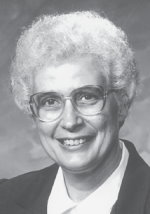
Order of Fun Nuns
The many consulting editors and cartoonists who have contributed to JN are listed on the right side of this page. We don’t have the space in this article to list all of the contributing subscribers to JN. We salute them all and thank these contributors from the bottom of our hearts.
Through the years, JN also has been blessed by contributions from some celebrated humorists:
Malcolm Muggeridge, “St. Mugg,” the former editor of the London humor magazine, Punch, before his conversion; the multitalented comedian Steve Allen, an eloquent advocate for clean comedy since his days as the host of NBCTV’s “Tonight Show”; Joe Garagiola, former co-host of NBCTV’s “Today Show” and Hall of Fame sportscaster with his endless hilarious anecdotes about baseball players; Bil Keane, creator of the beloved Family Circus cartoons, Johnny Hart, creator of B.C., and Ed Sullivan, who regularly focused on subjects often side-stepped by other cartoonists: God, religion, prayer, church, and heaven; Patch Adams, M.D., “the clown-prince of physicians.” (The movie, Patch Adams, chronicled Patch’s efforts to bring healing humor into deadly serious hospitals.)
The doctor as wit
As a young physician in Washington, DC, Patch became so serious about everything that he became deeply depressed, tried to kill himself, and committed himself to a mental hospital. There he discovered the healing power of humor and love, became a clown, and added humor and clowning to his medical practice.
“Joylessness prevailed not only on the hospital wards but in the medical school classrooms as well,” Patch wrote in JN. “All other facets of the patient’s life – family, friends, faith, fun, work, integrity, nutrition, exercise were considered virtually irrelevant to medical practice then.
“The psychiatry texts did not discuss any aspects of a healthy, happy life, much less suggest how to attain it. Instead, they were filled with descriptions of pathology and case histories of bizarre mental disease. Getting close to patients was forbidden. There was no friendliness or laughter.”
Patch added: “Patients who are full of God need less medication. If you do not have a strong value system that enriches your life, then your health is going to be affected.”
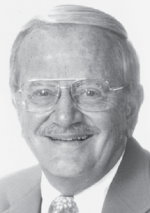
Laughter and
physical fitness
Cartoonist Bil Keane once observed in JN: “My friends Erma Bombeck and Art Buchwald have done far more for the health of humanity than Madame Curie or Dr. Christiaan Barnard.”
Many medical doctors, nurses, health professionals, and hospital chaplains, who value humor as a healing tool, also have contributed to JN. These health professionals also were keenly interested in promoting prevention, healthy lifestyles, physical as well as spiritual fitness, regular exercise, and good nutrition.
Another of our medical consulting editors, Dr. Donald L. Cooper, a Presbyterian, is a nationally recognized authority on sports medicine and physical fitness. He was appointed by President Reagan to the President’s Council on Physical Fitness and Sports. He was the football team physician at Oklahoma State University in Stillwater, OK. His wit and humor made him in much demand as a speaker.
In a 1990 issue of JN, Dr. Cooper described two of his own heroic battles with depression, one of which hospitalized him and brought him to the edge of suicide.
Dr. Cooper had these suggestions for a person suffering from depression: (1) Keep talking to doctors, counselors, pastors, friends. (2) “Never medicate yourself. Let the professionals prescribe the medication.” (3) “Cultivate a sense of humor.” (4) “Hang on to your faith.”
Dr. Cooper stressed the importance of good nutrition, regular exercise, play, and recreation as “necessary ingredients in the diet of all human beings.”
Another JN subscriber and a friend of Dr. Cooper, Dr. Rex Russell of Fort Smith, AR, wrote an outstanding book titled What the Bible Says About Healthy Living. Dr. Russell, a Mayo Clinic-trained radiologist, advised using good nutrition, regular exercise, and Biblical wisdom to improve your health and lift your spirits. He recommends many of the foods which the folks in the Old and New Testaments ate.
“The Philosophical Pharmacist,” Cliff Thomas of Belle Fourche, SD, and his collection of “Humor in Pharmacy,” tickled our funny bones. Cliff’s theme was “A laugh a day keeps the psychiatrist away.”
 We smile at the memories of the clowning of Presbyterians Rev. Bud (“Doolotz”) Frimoth and his wife, Lenore (“Wrinkles”) and Catholic clowns Ruby (“Tah-Dah”) Berkoski and Don (“Ski”) Berkoski of Smiles Unlimited, who were tireless in their clown ministries to hospitals, nursing homes, and prisons.
Our spirits were lifted by the joyful story of Father Stylianos Muksuris, pastor of Annunication Greek Orthodox Church in Kalamazoo, MI, which appeared in both JN and Prevention magazine. Fr. Stylianos improved his health dramatically by cutting out fastfoods and processed foods, eating lots of salads and fresh fruits, and walking three miles a day. He believes in both spiritual fitness and physical fitness, and that prevention is also a life choice.
When John Wesley, the founder of the Methodist Church, came to America from England in the l8th century, he marveled at the good health of Americans, and attributed it to "their continual exercise, universal temperance, and a natural diet." In America, he wrote, "diseases are exceeding few; nor do they often occur." Ben Franklin made the same observation. And Wesley encouraged pastors and parishioners to strive to be both spiritually and physically fit.
‘A House of Laughter’
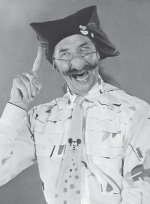
Patch Adams, MD
as the ‘nutty doctor’
at a seminar of the
Gesundheit Institute
There are many other precious memories. Who can forget Lutheran Pastor Paul Lintern’s entertaining articles on marriage and weddings or his delightful “Easter Carols”? Who can forget “Chaplain Bubbles,” Lieutenant Commander James M.T. Connolly, who illustrated his sermons to his Marines by blowing bubbles? (Chaplain Connolly, a Catholic, wrote: “Out on the front lines in Afghanistan the humor in JN is an awesome morale builder among the Marines I serve as chaplain.” For many years Chaplain Connolly has sent JN a monthly donation.)
And who can forget Quaker author Tom Mullen, one of the funniest people we’ve ever known and living proof that gentle humor can be hilarious? (Tom was a close associate of Elton Trueblood, author of the classic book,The Humor of Christ.)
Who can forget the joyful writings of wheelchair-bound Lois Ward? Or Anglican Pastor David R. Francoeur’s zany “Christmas gifts for clergy from the catalog of Balmy Clergy Supply,” which have appeared in JN’s Christmas issues for many years?
We were tickled by United Church of Christ Chaplain Cy Eberhart’s treasury of Will Rogers’ quotes and his portrayal of the rope-spinning, biracial Cherokee Indian cowboy who became America’s most beloved humorist, and by Arkansas humorist Jim Reed’s hilarious collection of jokes about politicians and preachers, golfers and preachers, and fishermen and preachers.
We were blessed by the merrymaking of Sr. Mary Christelle Macaluso of Omaha, NE, who founded the Order of Fun Nuns, and by the joy of Sherwood Eliot (“Woody”) Wirt, a close, longtime associate of Billy Graham, even into his nineties?
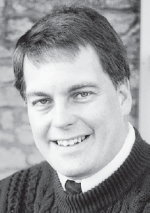
Lutheran humorist
who wrote
‘Easter carols’
We applaud the endless and ingenious hilarity of the Holy Humor Sunday services designed every year for many years by Rev. Dr. Karl R. Kraft of Glassboro (NJ) United Methodist Church; by Rev. Dr. C. Alan Harvey of the First Presbyterian Church in Winter Haven, FL; by Pastor Bob Thompson of Corinth Reformed Church in Hickory, NC; and by the many other pastors – male and female – who contributed to the ongoing celebration of Jesus’ resurrection on the Sunday after Easter in their churches.
We were charmed by the hilarious little church poems contributed by Australian Pastor Donald Prout; the joyful humor of Andy Fisher, former writer for NBC-TV’s “Today Show”; the amusing church “signs and wonders” contributed by Bobbe Lyon of Maitland, FL, and Rev. Dale Schoening of Renwick, IA; the comedy of Tommy DiNardo; and the wit of Phil Callaway and Rev. Dennis R. Fakes.
Who can forget Rev. Dr. O. Wendell Davis’s commentary on the great joy and humor often expressed in African-American churches? Rev. Davis, pastor of Union Chapel Missionary Baptist Church in Huntsville, AL, observed that many of the slaves developed a keen sense of humor, and that their Christian faith and sense of humor were survival tools under the most dreadful of circumstances. He said that a keen sense of humor was passed on from generation to generation.
We were tickled by the down-home-in-Indiana humor of bestselling author Philip Gulley, a Quaker; the entertaining articles on a minister in his parsonage by Rev. James L. Snyder, a pastor with the First Alliance Church in Ocala, FL; the zany humor in his book, You Might Be a Preacher If… by Rev. Dr. Stan Toler of Trinity Church of the Nazarene in Oklahoma City, OK; the charming epigrams of Lutheran Pastor Denny Brake of Raleigh, NC; the entertaining commentaries by Rev. Felix A. Lorenz Jr. of the Dearborn (MI) Christian Church; and the delightful humor and “Brother Blooper” cartoons of Rev. Dennis Daniel, pastor of the First Baptist Church of Fountain Hills, AZ.
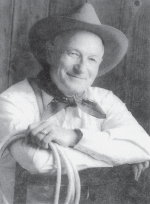
as Will Rogers
We remember with joy the effervescent joy of Lutherans Rich and Bob Bimler and Gina Bridgeman; Catholic Ann Ball’s collection of joyful saints in her book, The Saints Guide to Joy That Never Fades; the book Laughing Pilgrims by Howard R. Macy, professor of religion and Biblical studies at George Fox University; Stanley C. Baldwin’s book, A Funny Thing Happened on My Way to Old Age, which rejected the grumpiness of aging and showed how to cope with aging with faith and humor; the anecdotes of Prof. Jeff Totten of Lake Charles, LA, and Smiley Anders, Baton Rouge (LA) Advocate columnist.
We remember Rev. Jean W. Spencer’s touching tribute to cartoonist Charles Schulz, Peanuts, and Charlie Brown on their 40th anniversary. Wrote Rev. Spencer: “‘I like the prophets’ is Schulz’s explanation of why the Peanuts kids bring religion into Miss Othmer’s classroom. It’s OK to know and use the Bible. OK to laugh (even when things go wrong). It’s OK to keep trying again and again.”
“We live in a culture bombarded morning, noon and night with messages from films, TV, radio, recordings. It is almost impossible to escape encouragement to act in ways that have traditionally been the province of the libertine, thuggish, coarse, and depraved. Many popular comedians are horrified at what has happened to the beautiful and socially necessary act of comedy… The element of humor is necessary to human beings, necessary for the maintenance of sanity.”
—Comedian Steve Allen
recommending JN to pastors
And how can we forget the four pastors from a Christian Church (Disciples of Christ) in California who made up a barbershop quartet known as “Four Heaven’s Sake!”? These madcap merrymakers showed up dressed in the outfits of a televangelist, the Pope’s chef, a monk, and a rabbi. Rev. Dick Friedline, dressed in a tuxedo in his role as a televangelist, exhorted his audience to send money. “If every one in this audience would send just $250, we could all vacation in Hawaii!”
Even the originators of the famous Burma-Shave roadside signs, Allan and Grace Odell of Edina, MN, contributed to JN. Allan Odell (who was 90 when he subscribed to JN) originated the entertaining jingles and rhymes in 1927. This is one of the signs they passed on to JN:
In this vale
of toil and sin
your head grows bald
but not your chin
Burma-Shave
These are the people that our readers should thank, and pray for, because I, as the editor, am merely a conduit and facilitator.
I love you all!
The scholar as humorist
Two eminent scholars – one Lutheran and one Catholic – contributed immeasurably as consulting editors to JN before the Lord called them home.
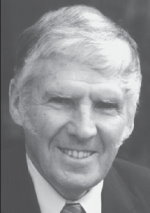
Associate of
Billy Graham
Lutheran Pastor Jakob Jonsson of the Icelandic Church in Reykjavik, a New Testament scholar, made an extensive study of “the fascinating world of rabbinic literature” and concluded that “the authors of the New Testament were influenced by rabbinic humor and the prophetic irony of the Old Testament.”
The Jewish rabbis, Jonsson wrote in JN, caught their students’ attention with humor, and Jesus also used humor to teach.
Tracing the Jewish roots of Christian humor, Jonsson authored a book titled Humour and Irony in the New Testament, Illuminated by Parallels in the Talmud and Midrash (published in English in 1985 in the Netherlands by E.J. Brill).
Dom Jean Leclercq, OSB, a distinguished Catholic historian and theologian, described himself as “a jester-monk” in the Benedictine Abbey of Clervaux in Luxembourg.
In an article in the September, 1986 JN, Dom Leclercq observed that “many of the sayings of the early Christian monks, who were known as the ‘Desert Fathers’ and who were renowned for their humor, were said with a smile or with tongue in cheek. Several were called by names meaning ‘the smiling one,’ such as ‘Hilary’ and ‘Hilarion.’”
Dom Leclercq sent JN a photograph of a smiling Christ on a cross carved from wood and dating from the 12th-century. It was found in the Cistercian monastery of Lérins in southern France. The smile on the crucified Christ’s face suggests the Resurrection.
Some of JN’s consulting editors, cartoonists, and contributing subscribers we’ve met, but many we have not met, and hope some day to meet them on earth or in Heaven. (From time to time in future issues of JN, we will revisit them and describe their contributions in more detail.)
‘The Risen Christ by the Sea’
One of the greatest contributions to JN was the painting of “The Risen Christ by the Sea” by Jack Jewell.
Jack Jewell was an elderly seascape artist living in a small Massachusetts seaport. His friend, Rev. Martin Clarke, a JN subscriber who was one of the chaplains to the New York Fire Department, asked him to paint a representation of a joyful, smiling Risen Christ.
Rev. Clarke was the predecessor to the chaplain, Rev. Mychal Judge, who was killed Sept. 11, 2001, in the attacks on the World Trade Center.
At the urging of Rev. Clarke, Jack Jewell donated the painting to JN, and it became JN’s logo in 1990.
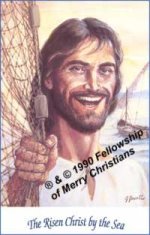
The painting has since enjoyed a phenomenal grass-roots popularity, appearing in church sanctuaries, social halls, conference and retreat centers, religious schools, and hospitals all over the country.
Many see it as a representation of “The Easter Laugh” – God’s last laugh on the devil when He raised Jesus from the dead.
On the back of the large prints offered by JN are these Scripture verses:
“These things I have spoken to you, that my joy may be in you, and that your joy may be full.” (John 15:11)
“When you fast, do not put on a gloomy look as the hypocrites do.” (Matt. 6:16)
“Happy are you who weep now; you shall laugh.” (Luke 6:21)
“Be of good cheer, I have overcome the world.” (John 16:33)
“The One whose throne is in heaven sits laughing.” (Psalm 2:4)
Is JN ‘The Health & Poverty Gospel’?
One of our friends, Rev. Dr. F. Christopher Anderson, a pastor in York, PA, and a humorist who is the author of God Is Still Laughing: The Revised Heidelberg Catechism Joke Book, once called our ministry “the Health and Poverty Gospel,” to distinguish us from “the Health and Prosperity Gospel” that some televangelists have been promoting. (The folks who tell you you’ll become wealthy and healthy if you follow Jesus.)
We get a lot of requests from prisoners for free copies of JN, and we send them.
Many of our clown subscribers with clown ministries have taken JN into hospitals, mental institutions, nursing homes, and prisons to cheer up hurting folks. Many subscribers have taken JN to hospitals and the sick and read it to patients and shut-ins.
A ministry built on laughter
“The assumption that a sense of humour and a Christian faith are incompatible is totally mistaken. In point of fact, the writers of the great classics of humour – Rebelais, Cervantes, Swift, Gogol – have all been deeply religious. Even comedians, like Bob Hope, tend to be believers rather than sceptics or cynics… Laughter is, indeed, God’s therapy. Let us then be thankful that, when the Gates of Heaven swing open, mixed with the celestial music there is the unmistakable sound of celestial laughter.”
—Malcolm Muggeridge
What has really amazed us is how many hundreds of thousands of people have been touched by a tiny monthly newsletter that has been operating on such a puny budget.
When we looked back and re-read 33 years of Joyful Noiseletters, we frequently doubled over with laughter, finding the humor as funny as ever. People often have told us that they find the humor in JN funnier than the stuff they see produced by national magazines. Perhaps some day we can put together a book on JN’s first 33 years.
We are thankful that JN’s renewal rate has been a steady 75% in good times and hard times, and that JN was honored by awards for excellence for newsletters from the Associated Church Press, the Evangelical Press Association, and the Catholic Press Association.
Over the years, we’ve also gathered a unique collection of books of religious humor that any library would prize.
In 2007, at the request of many of our subscribers, we began offering subscribers the option of receiving JN electronically or getting the paper version.
So many churches have reproduced our humor and cartoons in their newsletters, bulletins, and web sites that the reach of JN is far greater than its circulation.
We’ve made our share of mistakes, but in 33 years, we haven’t had a single complaint that we printed something in bad taste. We’ve been flattered that some unscrupulous people have stolen some of our best jokes without crediting JN, but Jack Benny had the same problem.
In the early years of JN, we sponsored well-attended national “playshops” with humorists, comedians, and clowns from all denominations. Among the speakers were Church of Christ humorists George and Peggy Goldtrap, Presbyterian Conrad Hyers, Quaker Tom Mullen, Lutheran Gina Bridgeman, Catholic clowns Don “Ski” and Ruby “Tah-Dah” Berkoski, Southern Baptist humorist Tal D. Bonham, Steve Feldman of Messianic Joy Ministries (with his collection of Jewish jokes), and Sr. Monique Rysavy, a Catholic nun.
Our one regret is that if we had had a sufficient budget and a staff, we could have done much more.
In this world from time to time, we all experience little deaths in our lives – illnesses, the loss of loved ones, financial hardships, etc. – and through the grace of God, we come alive again. They are little resurrections on earth before the great Resurrection.
When we started JN, we had a basic belief that we could all learn from one another – and we have. We found that we had much more in common than we had differences, and laughed at the same follies that we all shared.
We even found that we also had things in common with people of other faiths – our Jewish, Moslem, Buddhist, and Hindu friends – and even with secular humanists.
We thank God for bringing people together in good humor, civility, and camaraderie – qualities so missing in our modern world. And we thank God for the little resurrections in our lives, as well as the Great Resurrection.

Editor
Cal Samra
Consulting Editors
Patch Adams, M.D., Dr. Rich Bimler, Antoinette Bosco,
Gina Bridgeman, Phil Callaway, Rev. Brian Cavanaugh,
Donald L. Cooper, M.D., Rev. Dennis Daniel,
Rev. Dr. O. Wendell Davis, Tommy DiNardo,
Cy Eberhart, Rev. Dennis R. Fakes, Steve Feldman,
Andy Fisher, Winslow Fox, M.D.,
Rev. David R. Francoeur, Joe Garagiola,
George and Peggy Goldtrap, Philip Gulley,
Lou Jacquet, Mary M. Jordan, Rev. Karl R. Kraft,
Rev. Ronald P. Lengwin, Rev. Paul Lintern, Bobbe Lyon,
Prof. Paul L. Maier, Rev. James Martin, SJ,
Rev. Dale Schoening, Rev. Susan Sparks,
Rev. Jean W. Spencer, Dr. Stan A. Toler
Contributing Cartoonists
Cuyler Black, Dave Coverly, Dennis Daniel, James Estes,
Bill Frauhiger, Jonny Hawkins, Dik LaPine,
Scott A. Masear, Mike Morgan, Ron Morgan, Tim Oliphant, Steve Phelps,
Leigh Rubin, Harley L. Schwadron, Wendell W. Simons,
Richard Stubler, M. Larry Zanco
Celestial Consulting Editors
Steve Allen, Don “Ski” Berkoski, Tal D. Bonham,
Terry Buckner, George W. Cornell, Sandy Dean,
Rev. George S. DePrizio, Doc Goodwin, Johnny Hart,
Rev. Jacob Jonsson, Bil Keane, Rev. Warren J. Keating,
Dom Jean Leclerc, Sr. M. Christelle Macaluso, Archbishop
John L. May, Prof. Dick Means,
Rev. Norman J. Muckerman, Malcolm Muggeridge,
Tom Mullen, Rev.-Canon Alfred W. Price,
Rev. Donald Prout, Jim Reed, Barbara Shlemon Ryan, Sr.
Monique Rysavy, Goddard Sherman, Ed Sullivan, Rev.
Arthur Tonne, Lois H. Ward, Sherwood Eliot Wirt
| Shopping Cart |
| Cart is empty |
You can subscribe to the printed or electronic version of JN by:
- using our secure online store.
1 Year Subscription or Renewal — $29.00

1 Year Gift Subscription — $29.00
- filling out the Printable Order Form and mailing it, along with your check for $29, to The Joyful Noiseletter, PO Box 895, Portage, MI 49081-0895 (foreign printed subscribers add $10).
- calling TOLL-FREE, 1-800-877-2757, and using VISA, MasterCard, Discover, or American Express.